
John Henry

john-henry-2020

January 24, 2020
Thriller/Drama
R
United States
Director: Will Forbes

“A man is nothing but a man, but before I let your steam drill beat me down, I’d die with a hammer in my hand.”

The tale of John Henry is as confusing as it is fascinating. An ex-slave, John Henry went to work for the railroads, specifically C&O Railroad. His job was to drive holes into rocks with thick spikes. According to folklore, John Henry was the best at this, above all other men. For the day, he was a giant, standing at six feet tall. The end came when a salesman claimed his machine could drill holes better than any man. John Henry beat the machine fourteen feet to nine. Soon after, he died from exhaustion.

That’s how the general idea goes, anyway. It’s never been proven that John Henry actually existed, and the story changes depending on who’s telling it. What we do know is the point of the story: John Henry represents the heart of working men fighting a battle against machines.

So what does a man born a slave in the mid 1800’s have to do with a movie that takes place in Compton, California in the year 2020? In the film, John Henry (Terry Crews) is an ex-gang member who grows into a kind-hearted, soft-spoken man. It’s made clear throughout the film that John never wanted to be involved in the gang life, and tried to get out of it as soon as he could. The problem was his cousin, Hell (Chris “Ludacris” Bridges), who wanted to be king in the gang world. There’s only a brief glimpse toward the end of the movie when a piece of mail is picked up by John at his Gram’s (Baadja-Lyne Odums) house, which had the name “Helen Henry”. I could be mistaken, but that’s what it looked like, and it’s really no wonder why he went by the name Hell.

When they were younger, Hell (Maestro Harrell) and John (Rich Morrow) got into a slight tiff over John wanting to get out of the life. Hell forced a gun into John’s hand, and though it doesn’t show anything, it’s presumed by John’s father, BJ (Ken Foree), that John accidentally shot Hell, leaving the right side of his face either scarred or disfigured. We don’t really know, because all it shows is some sort of metal plate attached to his jaw.

So, the way the main part of the movie goes is that there’s a girl, Berta (Jamila Velazquez), who is taken by members of Hell’s gang to force her into sex slavery. Her brothers, Emilio (Joseph Julian Soria) and Oscar (Tyler Alvarez), come to her rescue by shooting everyone in the apartment that holds Berta and other girls who really don’t look like they want to be there. Berta and Emilio escape, but Oscar falls behind. When Emilio is stopped by police, Berta runs and hides under the porch of John Henry. When he realizes she’s there, he takes her in and feeds her.

It’s a beautiful couple of days. John, BJ, Berta, and eventually Emilio live in the house together with John trying to keep Berta and Emilio safe. Berta doesn’t really speak English, but they all communicate just fine. As I watched it, I couldn’t help but think how wonderful it was that these two cultures could come together and live so harmoniously. Even with John having to go out and by sanitary products for Berta the first night she’s there.

Everything seems to go well until Hell and his gang show up. They kill BJ and Emilio, shoot John, and take Berta. How John survived, I’m not sure (he was shot in the head, but the bullet ricocheted off, or something), and he goes to finish it once and for all.

John shows up on Hell’s front lawn with his huge hammer, is shot a few times by Gun (Gerald “Slink” Johnson), but manages to kill Hell with the help of another one of the gang members that Hell wanted dead, Savage (Daffany McGaray Clark). The bullets take a toll on John, though, as he falls to the ground. The last thing he sees before dying is Berta and Oscar (who is alive and brought out by Gun) leaning over him, and Berta thanking him.

Now, the first thing I noticed about this movie is that it has a very Quentin Tarantino-esque vibe to it, complete with comic book style stills and the type of music used. It bombed in the box office, and I can kind of understand why. It almost seems like it was a college movie project, trying to be artsy and not really succeeding. On Netflix, however, it’s booming, and I believe there is a very good reason for that. Terry Crews portrays a big, gentle man with a violent past extremely well (of course, Terry Crews is one of my all-time favorite actors, so I could be a bit biased), and the movie itself parallels the tale of John Henry in a unique way.

This is just my view: the gang represents slavery, John’s attempts to keep Berta and Emilio safe represents the fight for employment, and Hell is the machine that John beats, but is also his undoing. It’s not a family-friendly movie, and there are quite a few parts that just break your heart, but if you can get past the visual aspect, it really is a good one to watch. If anything, watch it for the message.

If you have a movie you would like me to review, leave a comment or send an email to spoileralertblog@outlook.com with “movie review” in the subject line.
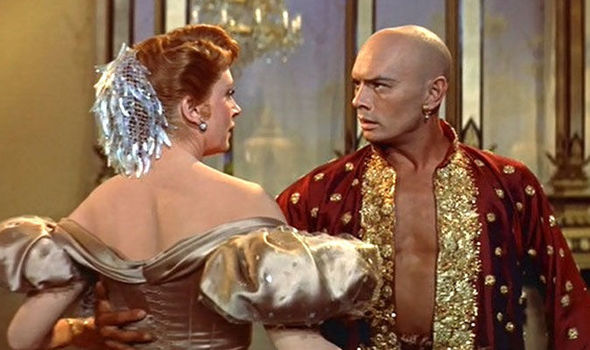
The King and I

thekingandi

June 29, 1956
Biography/Drama/Musical
G
United States
Director: Walter Lang

“Those who deny freedom to others deserve it not for themselves.” – Abraham Lincoln

This story takes place in Siam (presently known as Thailand) 1862. A schoolteacher from England, Anna Leonowens (Deborah Kerr), travels to Siam for work after she is widowed with her son Louis (Rex Thompson). She has been hired by King Mongkut (Yul Brynner) to teach his children English and scientific method.

It’s made clear from the beginning that Anna is a strong woman who will not bow in fear to anyone, not even the king. Mongkut is pleased by this, for it shows a strong mind, but throughout the movie, he gets increasingly more annoyed with her. At the same time, however, he appears to prefer her company above all others. Not only is she stubborn with him, but her kind nature never wavers, and he’s as drawn to her as he is confused by her. There is at one point where the English government is threatening to take over Siam because they see Mongkut as a “barbarian”. His first reaction is to fight fire with fire, but Anna cleverly talks him into providing them with a banquet and theatrical entertainment. And by “cleverly”, I mean she turns the words around to make it sound like it’s his idea. The result is the English government seeing how civilized and respectable the Siamese people are.

Anna does teach the children, as is her job, but she also teaches Mongkut. Not just with kindness toward other countries, but also to his subjects. He was raised that a man should take as many women as wives as he can, but a woman needs to be loyal to that one man. One of his many wives, Tuptim (Rita Moreno), is unhappy with the arrangement and runs away to meet with her true love, Lun Tha (Carlos Rivas). She’s captured, and the punishment for betrayal is being beaten with a whip. Mongkut is ready to do it himself and has his guards hold Tuptim on the floor, but Anna intervenes. She basically yells at him, telling him that she can’t believe he would do this and has no heart. He becomes frustrated, tosses the whip away, and storms out. The last we see of Tuptim is her being dragged away by the guards and overhearing that Lun Tha has been found in the river, dead.

Anna is infuriated with how the king and his staff behave – how they are so willing to destroy a life – that she’s determined to take her son and leave. However, Mongkut’s head wife, Lady Thiang (Terry Saunders), informs Anna that Mongkut is dying. Ever since Anna degraded him for being ready to beat Tuptim, he locked himself in his room and refused to eat or sleep. He spends three weeks like that, and Anna goes to see him on his deathbed. She had fallen in love with the people of Siam, and more specifically, the children she’s teaching. They beg her not to go, and it’s interesting to see that they care more about her staying than they do about their father dying. Anna had accused Mongkut of never loving anyone, and in that moment, it sort of shows. He had tried to be a good king and father, but he was doing what he had been taught. During the film, Anna shows him how different life is when one doesn’t treat those around him like slaves.

The end of the movie is Anna deciding to stay in Siam for the children, and the crowned prince, Chulalongkorn (Patrick Adiarte), begins to make proclamations as the new king, starting with celebrating the new year with fireworks and boat races, as well as subjects no longer bowing to the king, but instructing them better ways to show respect that doesn’t create fatigue on the body. As Chulalongkorn is doing this, Mongkut dies with Anna by his side.

This movie is one I’d heard about, but never really entertained the idea of watching. Not really for any particular reason; it just didn’t draw my interest. Why I watched it now is by the request of my dad. So, what do I think about it? Comedy is not in the list of genres this movie has, but I found Yul Brynner to be very amusing. I quite literally laughed out loud at most of the stuff he did with his performance. I was very much enjoying the film up until the end. It had a certain air about it: fun and charismatic. By the end of the movie, however, it just seemed to lose all that. I mean, it’s understandable given the fact that the king is dying, but I was sort of hoping for the fun to last throughout.

Having said that, this movie has an enormous amount of lessons that I think gives it more heart than a lot of films. One is the anti-slavery stance it takes. Anna is very outspoken in her views of how wrong slavery is, of which Tuptim finds most relatable, given her circumstance. Then there’s the pro-feminism aspect, which is apparent from the beginning, especially with Tuptim and how she’s a “gift” for the king, as if she were some object. They make mention a few times throughout about women being viewed as less than men; how their purpose is to please men. Anna comments on how absurd the notion is. Finally, there’s Mongkut’s death itself. While he dies with no one really mourning him, yet celebrating Anna’s decision to stay, it shows how important it is to not treat people as they’re any less significant than you, no matter your stance. Even a king.

I actually really do recommend this movie. The slavery and feminist issues that are brought up rather surprised me, what with it coming out in the fifties. Then again, it’s also based off of the book, “Anna and the King of Siam”, which came out in 1944 by Margaret Landon, which, in turn, is from the memoirs of Anna Leonowens in the 1860’s. Still, no matter how you look at it, The King and I is a very enjoyable film to watch and has a lot that can be taken away from it. I urge you to watch it.

Et cetera, et cetera, et cetera…

If you have a movie you would like me to review, leave a comment or send an email to spoileralertblog@outlook.com with “movie review” in the subject line.